




Inspecting a roof used to mean scaffolding, cherry pickers, or sending someone up a ladder – all of which cost money, take time, and carry working-at-height risk. For property and facilities managers responsible for multiple or hard-to-access buildings, that made routine roof inspection expensive enough to put off.
And put off it was: in our experience, the single most common reason a repairable defect turns into a full roof failure is simply that nobody had looked at the roof for years.
Drone surveys have changed the equation. A high-resolution inspection of an entire roof can now be completed in under an hour, with no access equipment, no disruption to the building below, and no one leaving the ground.
DL Jones Roofing Services integrates CAA-compliant drone roof surveys into inspections and maintenance programmes across London and the South East. This guide explains what a drone survey involves, when it is the right tool, what it costs relative to traditional access, and exactly what you receive at the end.
What Is a Drone Roof Survey?
A drone roof survey uses an unmanned aerial vehicle fitted with a high-resolution camera to capture detailed photographs and video of a roof from above. A trained, CAA-compliant pilot flies a planned pattern over the roof, recording the full surface, drainage outlets, flashings, upstands, rooflights, plant, and any areas of concern.
The footage is then reviewed by an experienced roofing surveyor to identify defects, assess overall condition, and inform a written report.
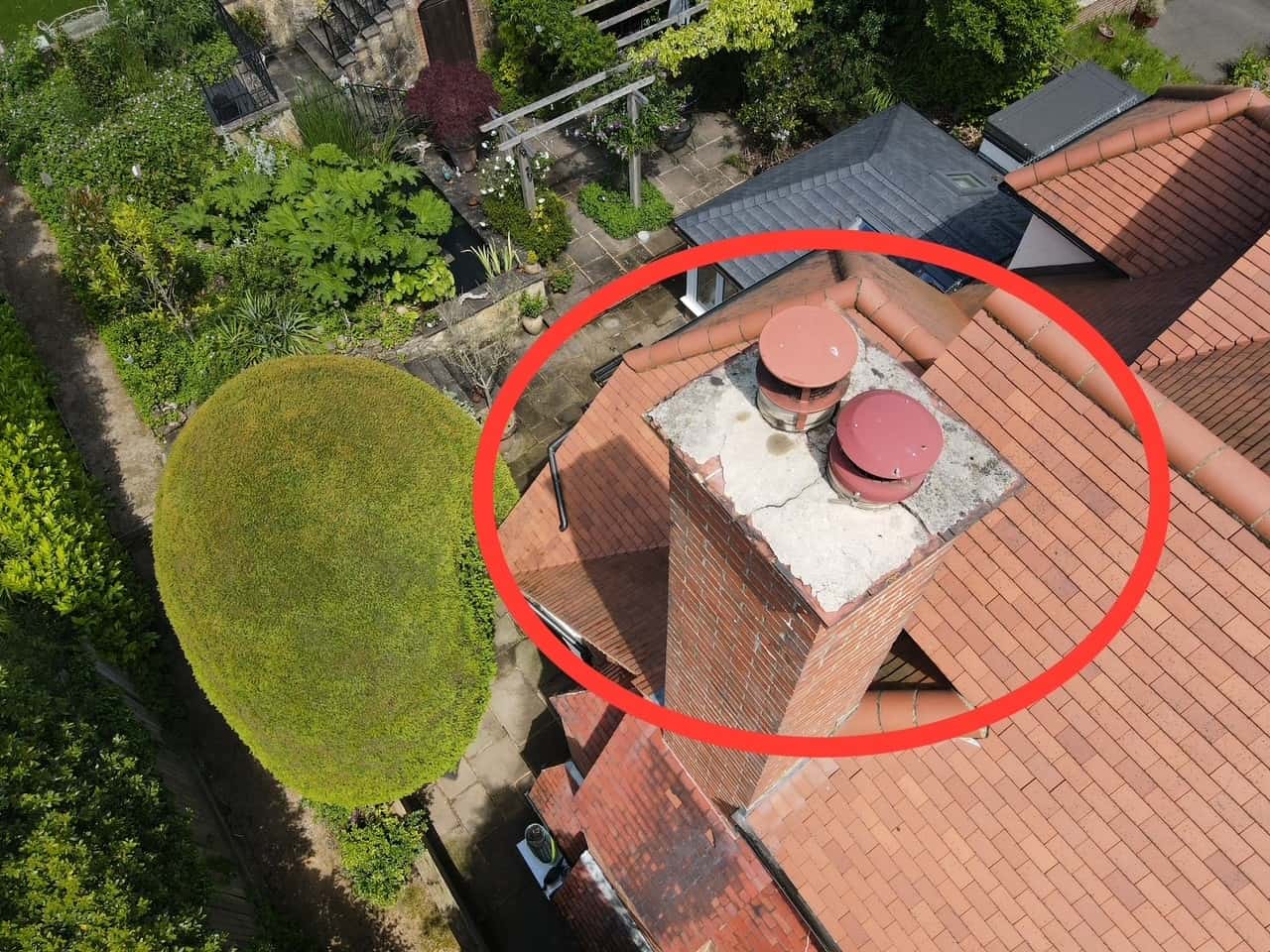
Modern survey drones capture imagery detailed enough to identify hairline splits in a membrane, displaced flashings, blocked outlets, and early ponding patterns – often more comprehensively than a walkover, because the camera sees the entire roof plane from above rather than at ground-level oblique angles.
Where the brief calls for it, thermal imaging can be added to the same flight, revealing trapped moisture and heat loss within the build-up that is invisible to the naked eye.
The key difference from a traditional survey is access. There is no scaffolding to erect, no MEWP to hire, and no operative exposed to working-at-height risk. For tall, fragile, or awkward roofs, that is transformative.
How a Drone Survey Works, Step by Step
The process is simpler than most clients expect. First, we carry out a pre-flight assessment: airspace checks, site constraints, weather, and any permissions needed for the location.
Second, on the day, the pilot briefs the site contact, establishes a safe take-off and landing zone, and flies a systematic grid over the roof – typically 20 to 45 minutes of flight time for a standard commercial building. Third, the imagery is reviewed by our surveyors, defects are logged and located on a roof plan, and a written report is prepared. Most surveys are booked, flown, and reported within days, not weeks – and because there is no access equipment, there is nothing to dismantle afterwards.
When Is a Drone Survey the Right Choice?
Drone surveys are particularly valuable when:
- Access is difficult or expensive – tall buildings, industrial sites and warehouses with large-span roofs, or sites where scaffolding would be disproportionate to the job
- The roof is fragile – fragile rooflights or asbestos cement sheeting where foot traffic is a genuine hazard to both the operative and the roof itself
- You manage a portfolio – rapid, repeatable inspections across many buildings, producing consistent, comparable condition data for asset management
- You need fast answers – a drone can be airborne in minutes, ideal after storm damage to assess multiple buildings quickly and prioritise emergency works
- Disruption must be minimal – no access equipment in car parks, playgrounds, loading bays, or operational areas, and no interruption to the building’s users
There are limits, and an honest provider will tell you about them. A drone inspects visually but cannot lift a flashing, probe a soft spot, or core-sample a build-up.
Flights are also weather-dependent – high winds and heavy rain ground the aircraft. For intrusive investigation, or where close physical inspection is needed, a drone survey is best paired with a traditional roof survey and report.
In practice the two work together: the drone identifies where to look across the whole roof, and a targeted physical inspection confirms the detail at the handful of locations that matter.
What Does a Drone Survey Cost Compared to Traditional Access?
This is usually the deciding factor. Scaffolding a single elevation of a mid-rise commercial building can run to thousands of pounds before anyone has inspected anything, and a MEWP hire with a trained operator is rarely cheap either – both often cost more than the survey itself.
A drone survey removes the access cost almost entirely, which is why it typically comes in at a fraction of the price of an equivalent scaffold- or MEWP-based inspection.
For portfolio clients the economics are even stronger: several neighbouring buildings can often be surveyed in a single visit, spreading mobilisation costs and producing a consistent condition dataset across the whole estate.
Exact pricing depends on roof size, location, and airspace, so we quote each survey individually – but it is very rare for traditional access to be the cheaper option for a visual inspection.
Is It Legal? CAA Compliance Explained
Commercial drone operations in the UK are regulated by the Civil Aviation Authority (CAA). A legitimate survey provider holds the appropriate CAA authorisation, carries adequate insurance, and follows flight planning rules around airspace, people, and property – including the additional permissions required near aerodromes and in congested urban areas, which cover much of London.
This matters more than many building owners realise: an uninsured or non-compliant flight over an occupied building is a genuine liability risk for the property owner as well as the operator.
Before commissioning any drone survey, ask to see the provider’s CAA authorisation and insurance documents. Always confirm your provider is CAA-compliant – ours are.
What You Receive
A professional drone survey should deliver more than a folder of raw footage. From DL Jones you receive high-resolution photographic and video documentation of the full roof; a written condition assessment identifying defects, drainage issues, and their locations on a roof plan; prioritised recommendations distinguishing urgent items from those to monitor; and – because we are roofers, not just pilots – practical advice on remedial works with indicative costings you can take straight to a budget holder.
The dated visual record has value beyond the immediate survey. It supports insurance claims after storm events, provides evidence for dilapidations and lease-end negotiations, and creates a baseline against which future surveys can measure deterioration — turning roof maintenance from guesswork into a managed, documented programme.
Why Use a Roofing Contractor for Your Drone Survey?
Anyone can take aerial photos. Interpreting them is the skilled part. A generic drone operator can tell you what a roof looks like; a roofing contractor can tell you what it means, how serious it is, and what to do about it.
Because DL Jones combines CAA-compliant flying with decades of hands-on roofing experience, our drone surveys translate directly into actionable maintenance decisions – and if remedial work is needed, the people who surveyed the roof are the same firm that can price and deliver the repair.
We deliver drone surveys for property managers, local authorities, and commercial clients across London, Surrey, Kent, and Sussex.
Frequently Asked Questions
How long does a drone roof survey take?
Flight time is typically 20–45 minutes for a standard commercial roof, with the full visit usually completed within a couple of hours. The written report normally follows within a few working days.
Can a drone survey be done while the building is occupied?
Yes. High winds, heavy rain, and poor visibility will postpone a flight. We monitor forecasts and confirm or rearrange in advance, so a weather delay rarely costs the client more than a short wait.
Can a drone survey replace a physical roof inspection entirely?
Not always. A drone provides an outstanding visual assessment of the whole roof, but it cannot lift details or probe the build-up. For most buildings, a drone survey either stands alone or pinpoints exactly where a targeted physical inspection is needed – which is still far cheaper than scaffolding the entire roof.
Need a fast, safe roof inspection? Book a drone survey or call us now 020 8657 0734