





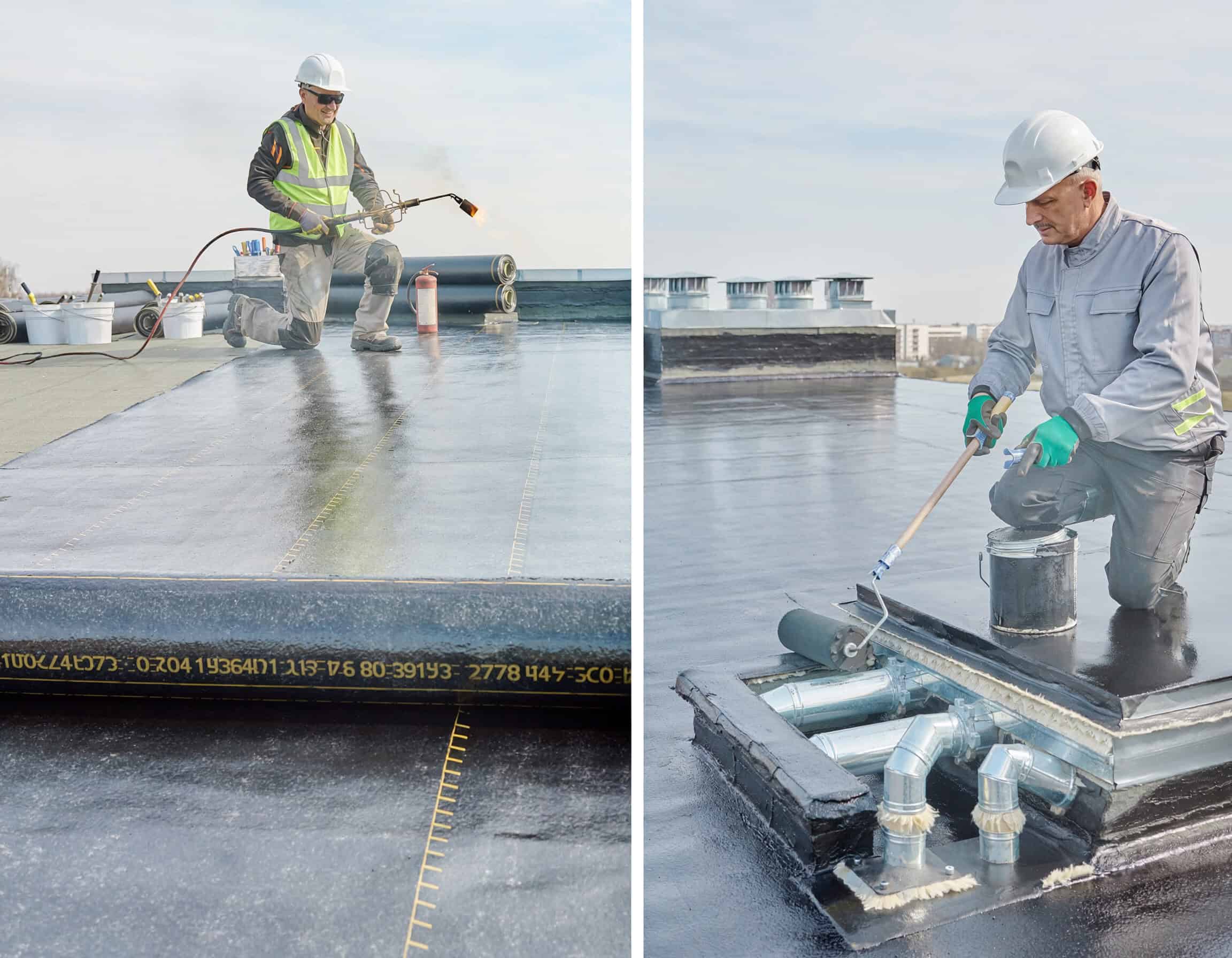

If you are specifying a new flat roof for a commercial, public sector, or residential building, two names come up again and again: Bauder and Polyroof.
Both are market-leading systems, both carry long manufacturer warranties, and both are installed by DL Jones as an approved contractor for each. But they are very different products – and choosing the right one depends on your building, its use, its roof shape, and how the works will be carried out.
At DL Jones Roofing Services, we have been installing both systems across London and the South East for many years. Because we are approved for both Bauder and Polyroof systems, we have no incentive to push one over the other – we recommend whichever genuinely fits the project. This guide explains the practical differences so you can make an informed decision.
What Is a Bauder Bitumen System?
Bauder bitumen membranes are a torch-applied or mechanically fixed, multi-layer waterproofing system. They are one of the most proven and widely specified solutions for large commercial and public sector roofs in the UK.
A typical Bauder build-up combines a vapour control layer, insulation, and a reinforced bitumen waterproofing membrane – engineered as a single integrated system rather than separate components.
Bauder’s strengths are robustness and track record. The membranes are physically tough, handle heavy foot traffic and maintenance access well, and have decades of proven performance on schools, housing blocks, and local authority buildings. Bauder systems also integrate cleanly with green roof and solar PV build-ups, making them a strong choice where a roof needs to do more than simply keep water out.
What Is a Polyroof Liquid System?
Polyroof is a cold-applied, liquid waterproofing system. Rather than rolls of membrane bonded with heat, it is applied wet and cures into a single seamless, jointless layer that follows every contour of the roof. Because there are no hot works, there is no naked flame on site – a significant safety and logistical advantage on occupied buildings.
Polyroof excels where a traditional membrane would struggle: roofs with complex shapes, numerous penetrations, pipes, upstands, and awkward detailing. It is the natural choice for occupied schools and hospitals where flame-free, low-odour, solvent-free installation matters. Being seamless, it also removes the joints and laps that are the most common failure points on any flat roof.
Bauder vs Polyroof: The Key Differences
Factor | Bauder Bitumen | Polyroof Liquid |
Application | Torch-applied or mechanically fixed | Cold-applied, flame-free |
Best roof type | Large, simple roof areas | Complex shapes, many penetrations |
Occupied buildings | Suitable with hot-works controls | Ideal — no flame, low odour |
Typical lifespan | 25–35 years | 20–25 years |
Warranty | Up to 25 years (approved installer) | Up to 25 years (approved installer) |
Green/solar ready | Excellent integration | Good for detailing-heavy roofs |
Which Should You Choose?
Choose Bauder if: you have a large, relatively simple roof area, you want maximum durability and the longest proven lifespan, or you are planning an integrated green roof or solar PV build-up. Bauder is the workhorse for big public sector and commercial roofs.
Choose Polyroof if: your roof has complex detailing, your building is occupied and sensitive to noise or fumes, or you are refurbishing rather than building new. The flame-free, seamless finish makes it the safer, cleaner option for live sites.
In practice, the right answer often only emerges after a proper inspection. That is why every project we quote begins with a roof survey and condition report – we assess the deck, drainage, and detailing before recommending a system, rather than the other way round.
Why It Matters That We Are Approved for Both
Approved installer status is not a marketing badge. It means the manufacturer audits our installation methods and that every system we fit qualifies for the full manufacturer-backed warranty – not just our own workmanship guarantee.
A contractor approved for only one system will, naturally, recommend that one. Because DL Jones is approved for both Bauder and Polyroof, our recommendation is driven by your building, not our certifications.
We install both systems across our flat roofing service for clients throughout London, Surrey, Kent, Sussex, and Essex – from single-building refurbishments to multi-block replacement programmes.
Not sure which system fits your building? Book a free flat roof survey – 020 8657 0734