





Introduction
Ask any school business manager what stands between their leaking roof and a replacement, and the answer is rarely willpower – it is money. School budgets have little room for six-figure capital works, and a failing roof does not wait politely for reserves to build up. That is precisely what the Condition Improvement Fund exists for.
The Condition Improvement Fund (CIF) is the government’s annual capital funding route for eligible academies and sixth-form colleges to address serious condition need – and roofing is consistently among the most commonly funded categories, because a failing roof threatens exactly what the fund is designed to protect: the safe, warm, dry operation of the school.
This guide explains how CIF works for roofing projects, what a strong bid looks like, and how the right contractor involvement early on materially improves both the bid and the eventual works.
What CIF Is – and Who Can Apply
CIF is an annual bidding fund administered by the Department for Education. It is aimed principally at smaller academy trusts and sixth-form colleges – larger multi-academy trusts generally receive their condition funding through a separate formula allocation instead, and local-authority-maintained schools are funded through their authority. If your school is in a smaller trust, CIF is very likely your main route to funding a major roof project.
The fund prioritises condition need: projects that address compliance and safety issues or prevent imminent building failure score most strongly. In practice, the categories that dominate successful bids are roofing, fire safety, electrical systems, and heating – and of those, roofing bids are among the most straightforward to evidence, because roof failure is visible, measurable, and its consequences are easy to demonstrate.
Why Roof Projects Score Well
CIF assessors are looking for evidence that a building element has reached the end of its serviceable life and that failure would disrupt education. An ageing school flat roof ticks every box: documented leaks into teaching spaces, closed classrooms, damaged equipment, saturated insulation driving heating costs, and repair histories showing escalating patch costs on a system that is past its design life.
The bid must prove this rather than assert it. That means an independent condition survey with photographic evidence, core samples or moisture mapping where appropriate, a repair log showing the trajectory of failure, and a clear statement of the educational impact – hours of teaching lost, rooms out of use, health and safety incidents. A professional roof survey carried out with CIF evidence requirements in mind is the single best investment a school can make before bidding, and a drone roof survey adds compelling whole-roof imagery without disturbing the school day.
The Bid Timeline – and Why Summer Is Too Late to Start
CIF runs on an annual cycle: the bidding round typically opens in the autumn term with a deadline in the winter, and outcomes are announced in the spring for delivery in the following financial year. The rhythm matters, because the strongest roofing bids are assembled months before the deadline – surveys commissioned in the summer or early autumn, costs obtained, and the technical case written without a scramble.
It also matters for delivery. Successful roofing projects are overwhelmingly delivered in the summer holidays, when the school is empty and the weather is kindest. A spring funding decision leaves a short window to procure the works, complete design, and mobilise for a July start – which is why schools that involved a contractor at bid stage, with buildability and phasing already thought through, move fastest when the money lands.
Building the Strongest Possible Bid
Beyond the condition evidence, assessors reward bids that demonstrate value for money and deliverability. For a roofing project that means realistic, professionally obtained costs rather than optimistic estimates; a specification appropriate to the building – typically a warm roof build-up that also brings the thermal performance up to current Building Regulations, turning a repair into an efficiency upgrade; a sensible programme showing holiday-period delivery; and evidence that the school can manage the project, usually through an appointed surveyor or project manager.
Many schools also strengthen bids by committing a modest financial contribution of their own, which signals seriousness. And because CIF is competitive – more schools bid than receive funding – an unsuccessful bid is not the end: feedback can be obtained, evidence strengthened, and the bid resubmitted the following year. Schools with a deteriorating roof should document everything in the meantime; unfortunately, a roof that has got worse makes a stronger case.
It is also worth remembering that CIF is not only for planned replacement. Where a building element fails suddenly and threatens the school’s ability to operate – a roof collapse or major storm failure being the obvious roofing examples – urgent support routes exist outside the main annual cycle.
No school should limp through a year with classrooms out of action on the assumption that nothing can be done until the next bidding round; take advice promptly, document the failure thoroughly, and explore the urgent options with your trust and professional advisers.
Delivering a CIF Roofing Project
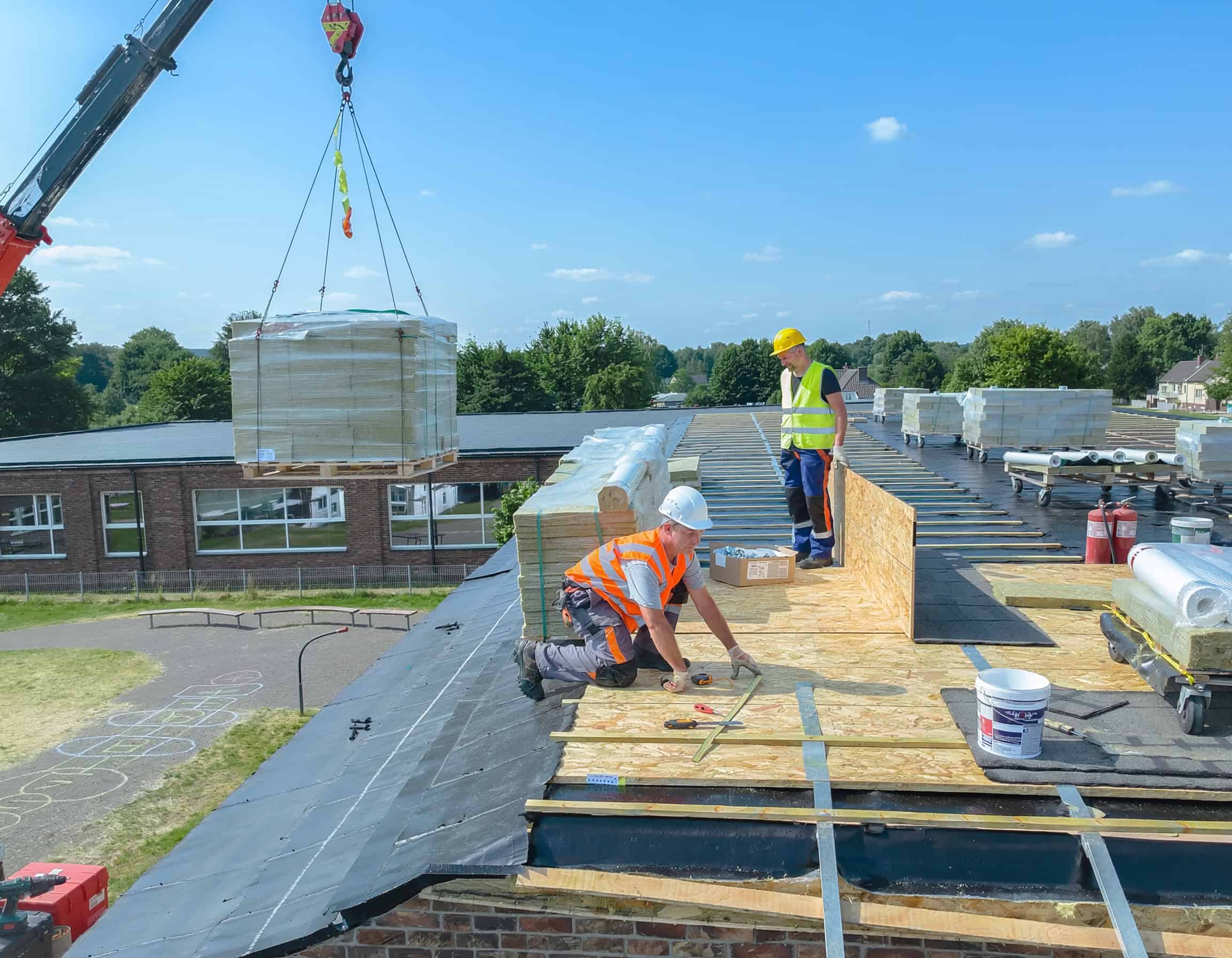
Once funded, the project must be procured properly and delivered within the funding period. This is where school-experienced contractors earn their keep: DBS-checked teams as standard, safeguarding procedures for any term-time attendance, strict segregation of work areas, and the planning discipline to complete strip-and-replace within a six-week summer window.
DL Jones has delivered exactly this kind of project – including flat roof refurbishment at Warlingham Park School in Surrey – and works with schools and academies across London and the South East from first survey through to manufacturer-warrantied handover, with Bauder and Polyroof systems carrying warranties of up to 25 years that outlast any funding cycle.
Frequently Asked Questions
Can local-authority-maintained schools apply to CIF?
Generally no, CIF is for eligible academies and sixth-form colleges. Maintained schools access condition funding through their local authority, which receives its own capital allocation. The evidence a strong roofing case needs is much the same either way.
Does a school need a full survey before bidding?
In practice, yes. An independent condition survey with photographic evidence is the backbone of a competitive roofing bid. Assessors need proof of condition need, not a description of it.
When should we start preparing a CIF roofing bid?
Ideally the summer or early autumn before the bidding deadline. That allows time for surveys, costed proposals, and a properly written technical case – and positions the project for summer-holiday delivery if funded.
What happens if our bid is unsuccessful?
You can seek feedback, strengthen the evidence, and resubmit in the next round. Keep documenting leaks, repairs, and disruption in the meantime – a well-evidenced deterioration record strengthens the resubmission.
Preparing a CIF roofing bid? Book a condition survey now – 020 8657 0734