


For property managers, facilities teams, and asset managers responsible for multiple buildings across London and the South East, roofing is one of the most significant sources of unplanned expenditure.
A leak that could have been prevented with a routine inspection becomes a major disruptive repair. A minor defect left unaddressed through one winter becomes a structural problem by spring. The cost of emergency reactive callouts consistently and significantly exceeds the cost of the planned maintenance that would have prevented them.
At DL Jones Roofing Services, we work with property management companies, local authorities, housing associations, and block management companies across London on planned roof maintenance programmes that replace reactive crisis management with a predictable, proactive approach.
This guide explains what a planned maintenance contract involves, why it makes financial sense, and what to look for when choosing a roofing contractor to deliver it.
The Real Cost of Reactive Roofing
The costs of reactive roofing go beyond the invoice for the repair itself. Consider what a significant roof leak in a commercial or residential building actually involves: the emergency call-out charge, the diagnosis, the temporary repair, the follow-up permanent repair, the internal damage to ceilings, finishes, and electrical systems, the disruption to occupants or tenants, the potential for insurance claims, and the reputational impact on the property manager.
Research across the property management sector consistently demonstrates that reactive maintenance costs three to five times more per square metre than the equivalent work carried out as planned preventative maintenance.
The economics of proactive roof management are not complicated – the challenge is the upfront commitment to a programme rather than waiting for problems to announce themselves.
What Does a Planned Roof Maintenance Contract Include?
Regular scheduled inspections
The foundation of any planned maintenance programme is a regular inspection schedule. At DL Jones, we typically recommend biannual inspections – spring and autumn – for most commercial and residential buildings, with more frequent visits for buildings with complex roofing systems or occupants with low tolerance for disruption such as hospitals and schools.
Each inspection covers the full roof surface, drainage systems, penetrations, flashings, upstands, perimeters, and any rooflight or skylight assemblies. The inspection produces a written condition report with photographic evidence, prioritised recommendations, and a clear distinction between items requiring immediate attention and those that can be monitored over time.
Gutter and drainage clearance
Blocked gutters and drainage outlets are responsible for a disproportionate number of roof-related water ingress problems.
Leaves, debris, moss, and silt accumulate in flat roof drainage systems and gutters throughout the year – particularly in autumn. A blocked outlet on a flat roof can cause standing water to back up, increasing hydrostatic pressure on the waterproofing membrane and eventually finding its way into the building.
Regular clearing of all drainage is one of the most cost-effective preventative actions available.
Minor repairs and defect rectification
A planned maintenance contract typically includes an allocation for minor repairs identified during inspections – small splits or blisters in the membrane, loose flashings, minor pointing defects around penetrations, sealant failures, and similar small defects.
Addressing these at the inspection visit, while the team is already on site, is far more cost-effective than returning on a separate reactive visit and prevents small defects from developing into larger, more expensive failures.
Drone survey integration
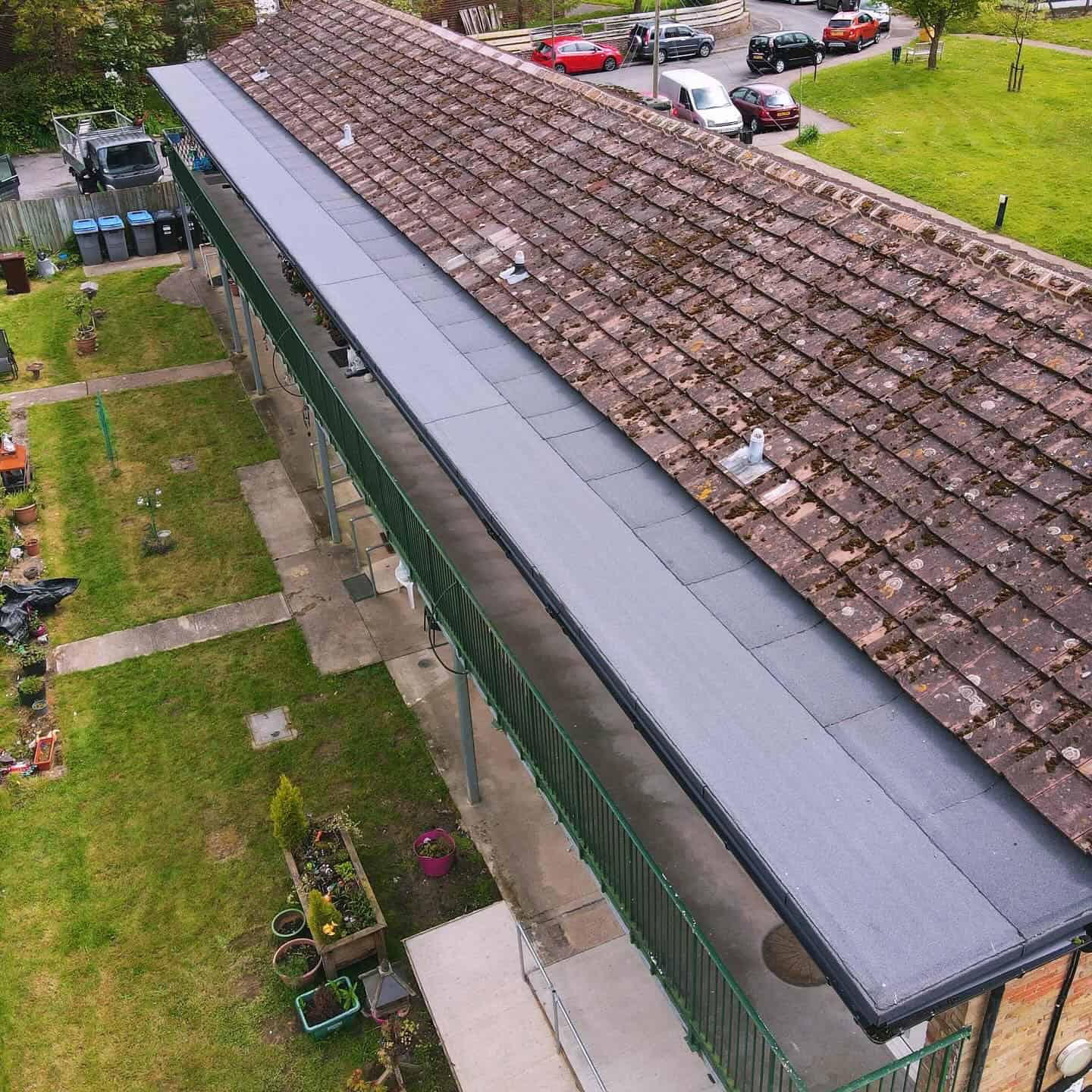
For larger or more complex roof areas – or for buildings where manned access is logistically challenging or costly – DL Jones integrates drone roof surveys into maintenance programmes. Our CAA-compliant drone surveys provide high-resolution photographic and video documentation of the full roof area, identifying defects, drainage issues, and areas of concern without the need for scaffolding or elevated access equipment.
The Compliance and Liability Dimension
For property managers and facilities teams, roof maintenance is not purely a financial consideration – it is also a compliance and liability issue. Landlords and property managers have a duty of care to ensure that buildings under their management do not deteriorate to a state that presents a risk to occupants or third parties.
A documented planned maintenance programme, with written inspection reports and a clear record of works carried out, provides the evidence trail that demonstrates this duty is being met.
In the event of an insurance claim arising from a roof-related incident, a maintenance record can significantly affect the outcome. Insurers are more likely to respond favourably when there is clear documentary evidence that the roof has been regularly inspected and maintained.
What to Look for in a Roofing Maintenance Contractor
- Accreditations and approved contractor status – look for NFRC membership, Bauder or Polyroof approval, and relevant health and safety certifications
- Experience with your building type and sector – a contractor experienced in commercial flat roofing and public sector environments understands the access, compliance, and reporting requirements
- Own directly employed teams – contractors who use their own labour rather than sub-contracting provide more consistent quality and greater accountability
- Clear written reporting – every visit should produce a written condition report with photographs, not just an invoice
- 24/7 emergency response – when an urgent issue arises outside of planned visits, you need a team you already know and trust available immediately
DL Jones: Maintenance Contracts Across London and the South East
DL Jones has been delivering roof repairs and maintenance to commercial, public sector, and residential clients since 1987.
We hold maintenance contracts with local authorities, housing associations, block management companies, and property managers across London, Essex, Kent, Sussex, and Surrey.
Our 24/7 emergency response capability means that when an urgent issue arises outside of planned visits, our clients have immediate access to an experienced team they already know and trust.
Our maintenance programmes are tailored to each client’s portfolio – the size of the buildings, the roof systems in place, the sector, the occupancy, and the budget.
We provide clear, transparent reporting and fixed-price contracts that allow accurate budgeting and eliminate the uncertainty of reactive-only roofing management.
Enquire about a planned maintenance contract: 020 8657 0734